

The 9 box grid is a well-known tool for talent management and succession planning. In this practical guide, we will explain how categorization in the 9 box grid works, the talent management action steps per category, and provide an Excel template for quick reporting. You’ll also learn how to run a 9 box assessment, how to use the grid in talent reviews, what each box means, and what to do next.
Contents
What is the 9 box grid?
Advantages and disadvantages of the 9 box grid
How to run a 9 box assessment
How to interpret the 9 box grid at a glance
The 9 box grid explained
How to use the 9 box grid in a talent review
Applying the 9 box grid in talent management
9 box grid for succession planning
Free 9 box grid Excel template and guide
Critique of the 9 box grid
What to use instead of a 9 box grid
FAQ
Key takeaways
- The 9-box grid is a talent management tool that maps employees by performance and potential. It helps identify whom to develop, who may be ready for bigger roles, and where extra support is needed.
- Don’t rate employees on instinct alone. Use performance data, feedback, and calibration across managers to make decisions fairer and more consistent.
- Grid placement should lead to action. Each box needs a clear response, from mentoring and stretch assignments to role changes or performance support.
- The tool can strengthen talent reviews and succession planning, but only if you use it carefully and avoid turning it into a labeling or forced-ranking exercise.
What is the 9 box grid?
The 9 box grid is a well-known talent management tool in which employees are segmented into nine groups based on two dimensions: performance and potential. Also known as the nine box grid, 9 box matrix, or performance-potential matrix, this model helps organizations structure talent decisions consistently. Its purpose is to closely align talent management and development initiatives with where they add the most value.
When making talent management decisions, it’s important to consider two things that will impact the organization’s success: how well the employees perform today—their performance—and how well they are likely to perform in the future—their growth potential—in line with what the organization wants to achieve.
For example, employees who do well in their roles but have limited growth potential are likely to consistently contribute within their positions. High-performing employees with great potential are expected to take on more complex roles in the future or become potential successors.
However, low-performing employees with low potential will require a lot of management attention and are unlikely to move into succession pipelines. These employee segments require different talent management approaches.

Advantages and disadvantages of the 9 box grid
There are several pros and cons of the 9 box grid. Its advantages include:
- Being simple and easy to use to make decisions: The 9 box grid model is an established tool with a fairly simple and straightforward structure. During your employee review, all you need to do is match them to the right box based on their performance and potential. The way the grid is visualized makes it easy to catch on, even for those completely new to this tool.
- Helping identify valuable talent: The 9 box grid allows you to spot high performers in your organization with great potential and identify what they need to improve to develop further. You’ll have the data to back up your decision of where and how to direct resources to engage and develop these employees. Additionally, when internal promotions come up, you’ll know exactly who to offer these opportunities to.
- A holistic approach to reviewing talent: This tool provides you with a more well-rounded approach to performance management. You won’t get sucked into a single element of an employee’s performance, and you will be able to assess both current performance and future potential.
- A versatile tool: The 9 box talent grid is useful not only for talent management but also workforce planning. This tool gives you a good overview of the potential of your employees and in which position they might thrive in the future. In other words, it makes succession planning easier. You can also use the 9 box grid to identify employees with leadership potential and move them onto management tracks.

On the other hand, its disadvantages include:
- Oversimplifying employee performance and potential: Reducing employees to just two dimensions, performance and potential, can leave out important factors like specific skills, motivation, role complexity, learning agility, and external circumstances. As a result, the tool may not fully reflect an employee’s actual value or future contribution.
- Relying heavily on subjective judgment: Managers often have to assess potential based on opinion rather than hard data. Unlike performance, which you can measure against clear goals and KPIs, potential is much harder to define and evaluate consistently. This can lead to bias, inconsistent ratings, and unfair employee placement in the grid.
- Risk of labeling employees: Once employees are placed in a certain box, it can be difficult for managers to look beyond that label. Someone marked as “low potential” or “low performance” may be overlooked for future opportunities, even if they improve over time. As a result, the grid can unintentionally limit employee development rather than support it.
- Missing context behind performance: The 9 box grid shows where an employee is now, but doesn’t always explain why they’re there. For example, a lack of support, unclear expectations, or personal circumstances may cause poor performance, rather than a lack of ability. Without deeper discussion, the grid can encourage surface-level decisions instead of more thoughtful talent reviews.
One of the most critical things to get right in talent management is prioritizing talent management efforts to where they will make the biggest impact. Using a tool like the 9 box grid can be immensely helpful to understand the internal talent landscape and make investment decisions.

How to run a 9 box assessment
Creating a 9 box grid involves five steps: evaluating performance, evaluating potential, and bringing the two dimensions together.
Step 1: Evaluating performance
The 9 box consists of three performance categories: low, moderate, and high. During their performance appraisal, employees are usually evaluated on this (or a similar) performance scale.
There are many ways to evaluate performance, and each organization uses different methods. As an example, we propose the following approach, regardless of the scale that you use:
- Low performance: The employee does not match the requirements of their job and fails their individual targets.
- Moderate performance: The employee partially matches the requirements of their job and their individual targets.
- High performance: The employee fully meets the requirements of their job and their individual targets.
The advantage of this approach is that it uses the objective job requirements as defined in the organization’s job structure as performance criteria. Some organizations may have less defined job structures and work more with personal targets. In that case, you can put more emphasis on assessing individual target achievement.
Step 2: Evaluating potential
The other axis of the 9 box grid considers individual potential. Potential should also be evaluated during the talent review process and often falls into the following categories.
- Low potential | Working at full potential: The employee is working at full potential and is not expected to improve, either because they are at maximum capacity or because of a lack of motivation.
- Moderate potential | Develop in the current role: The employee has the potential to further develop within their current role. This can be in terms of performance but also in terms of expertise.
- High potential | Ready for movement: The employee performs well beyond the expectations of their current position and responsibilities. They are likely ready to take on roles and responsibilities with more complexity.
Communicating your evaluation of potential has to be based on objective data. Through this process, you want employees to have a growth mindset and associate extra effort with improvements in performance. As such, communicating this requires some tact. For this reason, some companies decide not to communicate this potential score to employees.
Similarly, you should also be careful about telling employees they are eligible for a promotion. There may not be any job openings available at the moment to fulfill this.
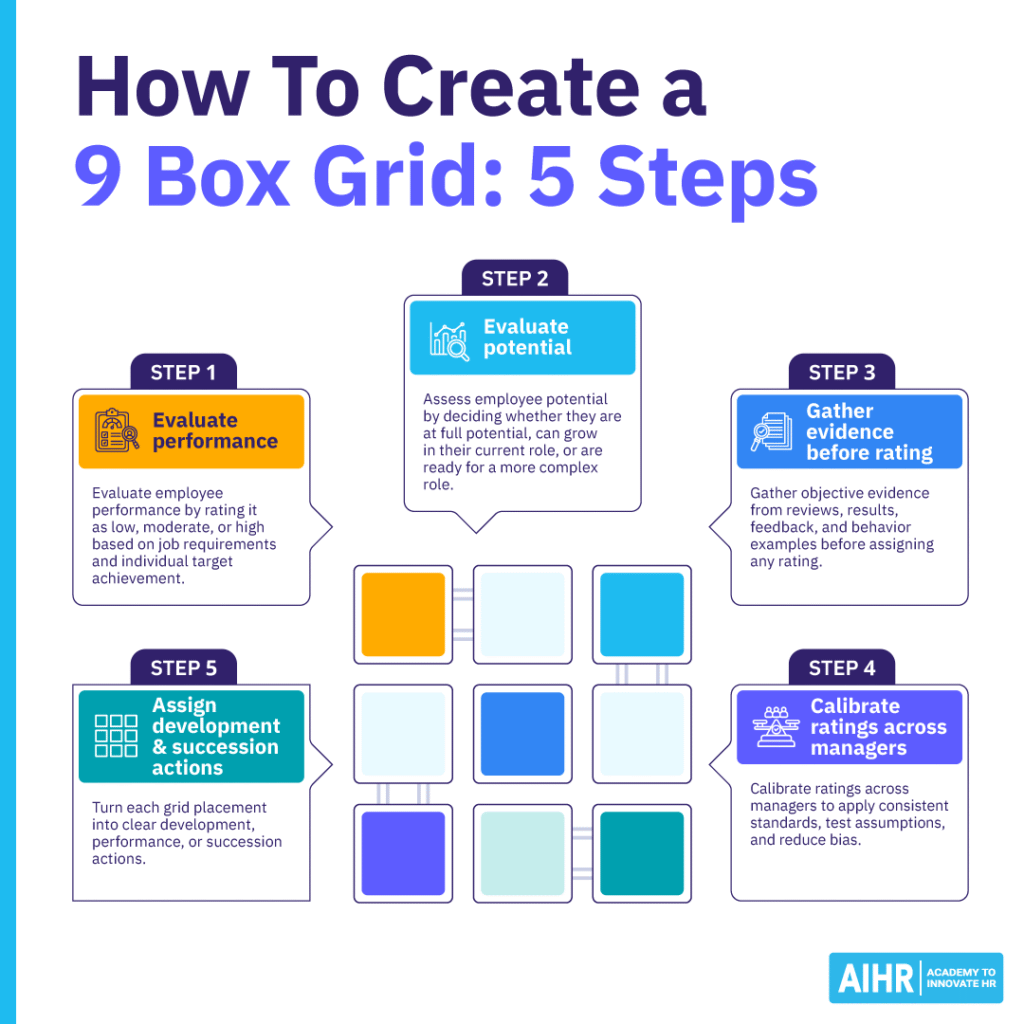
Step 3: Gather evidence before rating
Before placing employees in the 9 box grid, collect objective data to support your evaluation. This reduces subjectivity and leads to more consistent decisions across teams. Use multiple sources of evidence, such as:
- Recent performance reviews and appraisal scores
- Measurable business results (e.g., sales targets, project outcomes, KPIs)
- 360-degree feedback from peers, managers, and stakeholders
- Examples of behavior that demonstrate growth, leadership, or adaptability.
Avoid relying solely on a manager’s perception. For example, an employee they consider “high potential” should have evidence of learning agility, not just strong current performance. Taking the time to gather evidence upfront makes the 9 box talent assessment more credible and easier to defend during calibration discussions.
Step 4: Calibrate ratings across managers
Calibration is a critical step in the 9 box grid process. Without it, different managers may apply inconsistent standards when evaluating performance and potential. During calibration:
- Compare employees across all teams, not just within one team
- Challenge assumptions and require evidence behind each 9 box rating
- Align on what “high performance” and “high potential” look like in practice
- Identify patterns of bias (e.g., overrating or underrating certain groups).
For example, one manager’s “high performer” may be another manager’s “solid contributor”. Calibration helps create a shared standard to ensure fair assessment of employees across the company. This step is especially important in larger organizations, where multiple managers contribute to each 9 block assessment.
Step 5: Assign development and succession actions
Placing employees in the 9 box grid is only useful if it leads to clear follow-up actions. After employees are positioned in the grid:
- Define development plans for each individual
- Identify high potential employees for succession pipelines
- Address performance issues with targeted support or interventions
- Align actions with business priorities (e.g., leadership gaps, critical roles).
For example:
- High performance / high potential employees may be assigned stretch roles or leadership programs
- Medium performance / high potential employees may benefit from mentoring and targeted development
- Low performance / low potential employees may require performance improvement plans (PIPs) or role changes.
The goal is not just to categorize employees, but to make informed decisions about development, retention, and succession planning.
Segmenting and categorizing talent is not about placing people in boxes. Instead, it is about thinking what talent the organization will require in the future and ensuring a ready talent supply through targeted development and other initiatives.
How to interpret the 9 box grid at a glance
Before diving into each of the nine boxes in detail, it helps to understand the structure of the grid. The 9 box grid maps employees across two dimensions using a simple three-level scale (low, moderate, high). Each axis represents a different aspect of talent evaluation:
- Performance (X-axis): Reflects how well an employee is currently performing in their role. This includes factors such as goal achievement, quality of work, consistency, and contribution to business outcomes.
- Potential (Y-axis): Reflects an employee’s ability to grow into more complex or senior roles. This includes learning agility, leadership capability, adaptability, and readiness for broader responsibilities.
By combining these two dimensions, the grid creates nine possible employee profiles. The goal is not just to categorize individuals, but to support consistent decisions around development, succession planning, and talent investment. The table below summarizes what each part of the grid typically means in practice:
Low performance / low potential
Underperformer or poor role fit
Performance improvement plan, redeployment, or exit
Low performance / medium potential
Inconsistent performer with some growth potential
Coaching, skills development, role clarification
Low performance / high potential
Misplaced talent or new to role
Reassignment, targeted development, close support
Medium performance / low potential
Solid but limited growth
Maintain performance, focus on role stability
Medium performance / medium potential
Core contributor
Develop within role, incremental growth
Medium performance / high potential
Emerging talent
Stretch assignments, mentoring, leadership exposure
High performance / low potential
Expert individual contributor
Retain, deepen expertise, avoid forced promotion
High performance / medium potential
Strong performer with growth capacity
Prepare for next role, structured development
High performance / high potential
Future leader
Accelerate development, succession planning, retention focus
While this overview provides a quick reference, each box requires careful interpretation. Context matters, such as tenure, role complexity, and business needs. In the sections below, we break down each box in detail and explain what actions HR and managers should take.
The 9 box grid explained
In this section, we’ll go over the different categories in the 9 box grid and look at how the talent management approaches differ per segment.
Underperformers
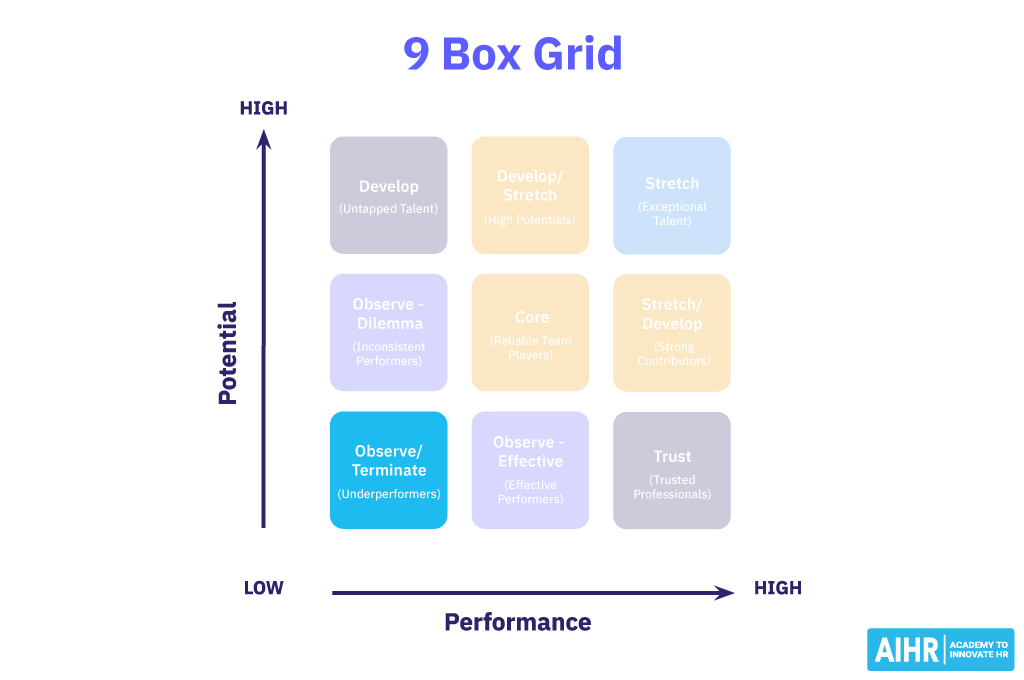
In the bottom left corner of the 9 box grid, there are the employees who score low on performance and low on potential. There are different names for them, which include talent risk, bad hire, underperformer, and iceberg. Some companies even go as far as labeling them as ‘useless workers’ who need to be ‘fired immediately’.
Put simply, your talent management efforts should focus on employees with greater potential for growth and contribution rather than on these underperformers. This strategic approach ensures high work quality across the team and prevents situations where team members compensate for others’ underperformance.
Ideally, the organization should actively seek more suitable roles for these individuals, aligning their skills with the organization’s needs and their career growth.
Action plan
- Identify personal roadblocks that may cause low performance and a lack of growth. However, be careful not to over-invest and know when to move them out or sever ties. Sit with the individual to see if there is a more appropriate assignment where they (and you) can utilize their skills better.
- If the first two options don’t bring quick wins, you should create an exit plan together where you help the person find a role that better suits their skills outside of your organization.
If these underperformers are a common phenomenon in your organization, review your talent acquisition and selection processes.
Up or out

The next category in the 9 box grid is the up or out category. It includes the medium performers with low potentials (effective performers) and the medium potentials with low performance (dilemmas).
The effective performers or specialists are medium performers, but they do a good enough job. This makes them a challenging group. Investing time and money in training them will likely not pay off. The best approach is to create a performance improvement plan. With the creation of this plan, you help them understand where their points of improvement are, and you give them the opportunity to work on them.
If this is not paying off and they are not moving into the high-performance group, you will have to make a difficult decision, hence: up or out.
The dilemmas or inconsistent performers have some potential to be great, but they are not performing. Here, the question is why they are not performing. You need to go through the same process as before and try to identify what causes their average performance. Are they new hires, and did they have a poor onboarding experience, or maybe they don’t understand what you expect from them
As an intervention, you can enroll them in peer coaching or other mentorship programs. If this is not working and they are not progressing into a higher performance category, you will have to make a difficult decision.
Action plan
- Create a performance improvement plan by going over personal roadblocks and skills required for the role that the employee needs to work on. Provide measurable expectations and clearly define what good performance will look like. The employee should clearly know what is expected of them.
- Check in every month and evaluate progress on the plan. Always document these meetings well, as this will help you make a better decision. The employee will also benefit from a structured plan and feedback.
- If performance does not improve within six months to a year, you should create an exit plan together where you help the person find a role that better suits their needs outside of your organization.
Untapped talent and trusted professionals

In the bottom right corner and top left corner, we find people who excel in only one element of the 9 box grid.
The trusted professionals score high in performance but low in growth potential. They are the ones you should take care of in your organization. They perform well and have a good work mentality.
However, they likely don’t have much potential for growth. This means that you should keep them engaged and reward them for their contribution. However, be careful of over-rewarding these employees to the extent that they have limited ambition and opportunity for movement and growth.
Action plan
- Ensure that these employees are motivated and engaged to make a meaningful contribution.
- Analyze how their work will change in the future and help them prepare as far as possible.
- Raise salaries nominally, but be careful with substantial raises and bonuses. Do not promote beyond their potential.
The untapped talent, also referred to as enigmas or rough diamonds, is on the other end of the spectrum. They score high in potential but low in performance. An example could be a management trainee from a prestigious university. They haven’t learned the ropes yet, but they are eager to learn. Here, it is key to continuously track their performance – they should grow and increase their performance rapidly.
Action plan
- Give these employees time to develop, but monitor their performance. You are not only looking for improvements but for stable, solid performance. Keep in mind that it is easy to improve if performance is bad; if they are high in potential, they should be able to perform at a medium to high level within six to twelve months.
- Communicate clear expectations for their current role so they know what is expected of them.
- Communicate that you believe in their potential, but also that they should improve their current performance.
- If they still score low in performance a year onward, you should create an exit plan together where you help the person find a role that better suits their skills outside of your organization.
Future stars

We labeled the next three 9 box grid segments as ‘future stars’. They already make up the core of your workforce while also having the potential to grow into more advanced roles.
Your high potentials or emerging contributors show high potential but are average in performance. Oftentimes, this is because they haven’t had time to fully grow in the role yet. The priority here is to move them to the right position in the 9 box grid, so they are in the top-right corner. The approach and action plan are similar to those of your reliable team players.
Your reliable team players are consistent performers who also have the potential to grow further in their current roles. Your main priority is to bring these people to the right of the 9 box grid, where they score high on performance. The steps here are similar to those for your high potentials.
Action steps
- Ensure that expectations and role requirements are clear.
- Give employees who are new in their roles the time to develop their performance to the highest level.
- Consistently praise accomplishments, good performance, and initiatives that help to advance organizational goals. Also, monitor their performance and have regular sit-downs to ensure that they are still happy in their role.
- Expose them to short-term job rotation schemes to expose them to other experiences that will help them perform better or job enlargement by adding activities that fit the employee.
- Enable them with peer coaching by a high-performing employee or professional coaching to solve any personal or professional issues that hold the person back. In other words, help them overcome performance barriers.
- Provide these professionals with classroom training and on-the-job learning opportunities that help them develop the skills that they are good at or bring skills that hold them back to a higher level.
Strong contributors are already contributing to your organization, so the key strategy here is to keep them meaningfully engaged while ensuring that they will be up for the job not just now but also for years to come. If the strong contributor is ambitious and looking to move upward in the organization, you will want to improve their potential with different interventions.
Action steps
- Keep high performers happy and engaged. Regularly check in with them and appreciate the work they do.
- Not everyone needs to be a star. If your high performer is happy in their current role and does not want a promotion or extra responsibility, that is also a great outcome. It is not feasible to promote the entire organization every few years, so this may be a preferred option.
- Give them time to grow. If someone is not yet at full potential, it may mean that they need to grow more into their current role before they can move on to the next.
- Leverage techniques like job rotation and give them challenging assignments to expose them to different parts of the business. This will build their business acumen and prepare them for a broader leadership role.
- Find them a mentor who can help them grow and fulfill their ambition and provide training (and upskilling) opportunities.
Exceptional talent

The exceptional talent, also referred to as future leaders, are your high performers who are also capable of taking on new roles. These are your A-players and most valuable employees. They also play a critical role in succession management.
Action plan
- Give your stars challenging assignments – they are the most likely of all your employees to pull it off. Examples are important internal projects, turnaround projects, or more external opportunities in start-ups or spin-off companies.
- Check-in with them regularly and assess if they are still happy in their current role. Ensure that you spot early signs of dissatisfaction. Praise them lavishly and ensure that they feel appreciated for the contributions they make to the company.
- Provide mentorship with more senior members of the organization
- Create networking opportunities with other stars and with senior members of the organization. These opportunities help to build a network between your top performers and your senior leadership.
- If they are interested in it, roles in external boards and committees could incentivize them, raise their public profile, and provide an interesting challenge and networking opportunity for them.
- Reward them and ensure that they receive competitive compensation. These employees contribute the most to your organization, and you should reward them accordingly.
Build the skills you need to identify, map, and deploy talent using a skills-based approach to create an agile, diverse, and productive workforce.
In AIHR’s Talent Management and Succession Planning Certificate Program, you’ll learn how to:
✅ Use the 9 box grid to execute efficient talent mapping for your organization
✅ Take advantage of capability and skills maps to determine talent demand
✅ Master talent segmenting and demand forecasting to make your workforce resilient
How to use the 9 box grid in a talent review
The 9 box grid is most commonly used as part of a structured talent review or performance review process. Rather than evaluating employees in isolation, it allows leaders to assess talent consistently across teams, and make better decisions about development, succession, and retention.
Who should participate
A 9 box talent review typically involves:
- Direct managers, who provide performance and potential input
- Senior leaders or HR, who help calibrate and align ratings
- HR business partners (HRBPs), who facilitate the discussion and ensure consistency.
In larger organizations, multiple managers come together to review employees across departments. This helps create a shared standard for what “high performance” and “high potential” mean in practice.
How the talent review meeting works
A typical 9 box talent review follows a structured discussion:
- Each manager presents their team members, including evidence for performance and potential ratings
- The group discusses and challenges these ratings to ensure consistency
- They then place employees into the grid based on agreed criteria
- They resolve differences in scoring through discussion and calibration.
For example, if one manager rates an employee as “high potential”, others may request specific examples of leadership behavior or growth indicators before agreeing on that employee’s placement. This process helps reduce bias and ensures ratings are based on evidence, rather than individual perception.
How the decision-making process works
Once employees are positioned in the grid, the focus shifts from evaluation to decision-making. Organizations typically use the 9 box grid to:
- Translate grid placements into individual development plans
- Assign clear actions (e.g., mentoring, stretch assignments, role changes)
- Track progress over time instead of treating the grid as a one-off exercise
- Revisit the grid regularly (e.g., every six to 12 months).
Applying the 9 box grid in talent management
One of the key advantages of the 9 box grid is that it makes talent investment decisions easier. For example, a company may allocate 60% of its development budget to high potential employees, while limiting investment in consistently low-performing roles.
Select International, an employee screening company, offers an interesting perspective. They propose that your total talent management and development budget should be allocated based on one’s position in the 9 box talent matrix.

If you had to invest $100, you should divide it among the different talent categories, as shown in the figure above. Underperformers who occupy the bottom left corner should be invested in the least, while the exceptional talent in the top right corner should get the most resources.
This also makes sense from a resource allocation and strategic perspective – as a business you will want to invest in the (human) resources that provide the largest return and that create the biggest competitive advantage. Investing in underperformers would take away resources from good and top performers.
This does mean that not everyone is equal – a message that not all HR professionals appreciate. It’s important to accept that some people fit an organization’s culture better than others, and not everyone is equally suited for the same role.
9 box grid for succession planning
In a similar vein, organizations use the 9 box grid for succession planning as well. In practice, organizations often combine the 9 box grid with succession planning frameworks to identify ready-now and ready-later candidates. Succession planning should focus on your stars, who score high in performance and high in potential. These are the employees who will build the future of your organization.
The 9 box grid is a tool that helps in the identification of leadership talent. You can then develop these potential leaders for more senior leadership positions through leadership development, (performance) coaching, mentoring, regular 360-degree feedback, and other feedback methods.
The stars are the key employees in the succession matrix, where critical roles are mapped, and different top employees are mapped in terms of their suitability for a role. When these roles become vacant, it means that there is talent ready to fill these newly opened roles.
Free 9 box grid Excel template and guide
A 9 box grid template helps structure your talent review and ensures consistent capture of employee evaluations. AIHR has developed a free template you can download and uses to support your company’s talent management process.
When to use the 9 box grid template
Use a 9 box grid template:
- Before a talent review session to prepare initial ratings
- During the session to visualize and discuss employee placement
- After the session to document decisions and follow-up actions.
For example, managers may complete a draft version of the grid before the meeting, which is then reviewed and adjusted during calibration discussions.
What to include in your template
A practical 9 box grid template should include:
- Employee names and roles
- Performance rating (low, moderate, high)
- Potential rating (low, moderate, high)
- Current placement in the grid
- Notes or evidence supporting the rating
- Agreed development or succession actions.
Adding notes is especially important, as doing so helps explain why someone was placed in a specific box and provides context for future reviews.
How to use the template in a talent review
During a talent review session:
- Display the grid so all participants can see placements clearly
- Move employees across boxes as ratings are discussed and calibrated
- Document key decisions directly in the template.
For example, if an employee is moved from “medium potential” to “high potential” during the discussion, record the reason and any agreed development actions immediately.
How to use the 9 box grid template after the review
After the session, the template becomes a working document for follow-up:
- Translate placements into individual development plans
- Assign ownership for development actions
- Track changes in placement over time.

Critique of the 9 box grid
Although the 9 box grid provides a clear way of managing talent and performance, it’s not undisputed. Its biggest shortcoming is arguably its connection to traditional performance management, characterized by a once-a-year, subjective rating by one’s manager.
Many companies, including Accenture and Deloitte, have moved away from annual performance reviews, opting for continuous feedback instead. This provides more opportunities to improve performance as well as more data points to assess performance accurately.
We highly recommend measuring performance using as many objective data points as possible. Continuous feedback loops, as well as goal-setting systems such as SMART goals or objectives and key results (OKRs), can serve a purpose here.
Additionally, transparency is key. Without clear communication about talent management practices, the system can fail to achieve its goal and may result in a “rank and yank” system, where employees are ranked against each other and the lowest end of the ranking is terminated (the yank). The 9 box grid does not intend this. Instead, it should be leveraged to develop and cultivate talent and, through talent, build a sustainable competitive advantage for the organization.
What to use instead of a 9 box grid
While the 9 box grid is widely used, some organizations adopt alternative approaches depending on their needs. Common 9 box grid alternatives include:
- Simplified 4 box grid: A stripped-down version of the 9-box that groups employees into four performance-potential categories to make talent discussions faster and easier.
- Skill Will Matrix: A four-quadrant model that assesses employees by both capability and motivation, so managers can tailor coaching and support.
- Competency models: Frameworks that define the skills, knowledge, and behaviors needed for success in a role, and measure employees against them.
- Talent profiles: Employee summaries that capture skills, strengths, achievements, and career goals to support development and succession decisions.
- AI-driven predictive models for talent management: Analytics-based tools that use data like performance, engagement, and learning activity to predict potential, risk, and development needs.
Next steps
The 9 box grid can be a useful tool to manage employees with different levels of performance and potential in your organization. As such, you can use it for performance management, talent management, and succession planning.
To use the 9 box grid well, you need skills in talent mapping, talent reviews, succession planning, and building strong leadership pipelines. AIHR’s Talent Management & Succession Planning certificate program helps you build these skills, with dedicated learning on skills-based talent mapping, succession planning, and talent reviews.
FAQ
The 9 box grid is a well-known talent management tool in which employees are segmented into nine groups, based on their performance and potential.
To create a 9 box grid, you go through three steps: evaluating performance, evaluating potential, and bringing those two together.
The 9 box grid can, for instance, be used as a basis for talent management (i.e. talent investment decisions) and succession planning.
After you’ve finished evaluating the performance and the potential of your employees and bringing them together, you can now map your employees onto the grid. Match them with the box that would fit their profile most. You can then use the result of your 9 box assessment to implement specific coaching, development, and talent management strategies for different groups of employees.
A 9 box assessment is a talent management method that places employees into one of nine boxes based on two factors: current performance and future potential. The goal is to help segment talent, understand who can grow into bigger roles, and decide where development and talent investments will have the most impact.
The 9 box grid is often tied to traditional annual performance management, which can rely on subjective manager ratings instead of ongoing, evidence-based feedback. Additionally, if you don’t communicate the process clearly, it can lose trust and drift into a forced-ranking or “rank and yank” approach, where employees are compared against one another and those at the bottom are pushed out.
In talent reviews, the 9 box grid is used to assess employees on performance and potential, then map them into the grid so HR and leaders can discuss the right action for each group. The value lies not in labeling people but in using the evaluation and follow-up discussion to guide coaching, development, talent investment, and succession planning decisions more effectively.