
Disciplinary action is an essential tool for managing unwanted behavior in the workplace. As uncomfortable as it may be, it plays a key role in building an environment people want to work in and keeping standards consistent across teams.
And it’s not an edge case. A global survey by the International Labour Organization found that more than one in five people have experienced violence and harassment at work during their working life. The EEOC also reported 88,531 new discrimination charges in a single fiscal year, which shows how often workplace issues can escalate when organizations don’t handle problems fairly and consistently.
In this article, we’ll dive into what disciplinary action is, share practical examples, walk through the steps you can take to handle it as clearly and consistently as possible, and provide a free form and letter to help you document the process.
Key takeaways
- Disciplinary action helps manage unwanted behavior and maintain workplace standards
- Common reasons for disciplinary action include misconduct, absenteeism, tardiness, and safety violations
- A clear disciplinary action process involves identifying issues, investigating, and holding hearings as needed
- Documenting disciplinary actions, including clear expectations and potential consequences, is essential
- Creating a strong disciplinary action policy fosters consistency and fairness in addressing employee behavior.
Contents
What is disciplinary action?
Disciplinary action examples
Reasons for disciplinary action at work
Disciplinary action process: 7 steps
How to write a disciplinary action for an employee
Disciplinary action form template
Disciplinary action letter template
Disciplinary action policy: What to include
FAQ

What is disciplinary action?
Disciplinary action is a corrective measure a company takes when an employee fails to meet performance expectations or behavioral requirements set by the organization’s policies, procedures, and laws. For example, an employee might receive a verbal warning from their manager or HR for being late to work.
The primary goal of disciplinary action is not to punish the employee. It’s to correct the employee’s behavior while documenting the issues in case the problem occurs again. Employee disciplinary action may involve the manager, HR, or both, depending on the organization and the severity of the issue.
Depending on the organization and available resources, HR’s role in workplace disciplinary action varies. In some companies, HR is only involved in more serious disciplinary actions. In other organizations, they may be involved in all disciplinary meetings. In both cases, HR is responsible for outlining a disciplinary action policy and formalizing procedures for responding to violations of the company’s rules. Generally, these policies are outlined in the employee handbook.
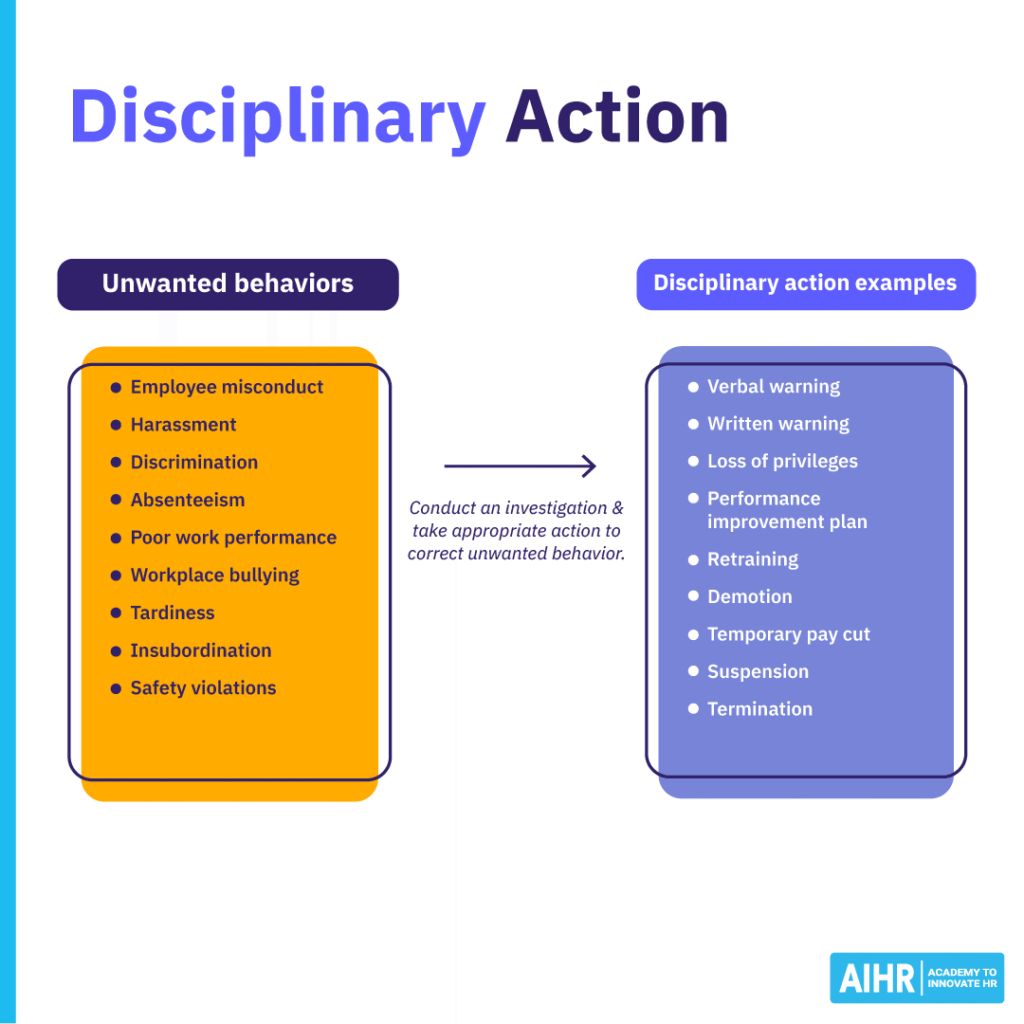
Disciplinary action examples
Employers have multiple options for disciplinary action. Usually, the goal is to correct poor performance or behavior by identifying the problems, causes, and solutions rather than punishing the worker.
This requires you to have a progressive discipline policy in place. That means the corrective steps begin with the lowest severity and only become increasingly severe if an employee fails to correct the situation after being given an opportunity to do so.
Here are some examples:
A verbal warning
A verbal warning is a step in which a manager or supervisor talks to an employee about problems involving workplace behavior, conduct, or overall job performance. Generally, if it is the team member’s first warning or the issue is minor, all you need is a one-time verbal reprimand.
A written warning
This kind of warning is in the form of a written document that alerts the employee to their misconduct in the workplace. Generally, a letter of reprimand will include the possible consequences if the team member does not fix their conduct.
Loss of privileges
It is sometimes possible that poor employee behavior is related to certain privileges, for example, recklessly driving a company car, spending too much money on a business credit card, and getting too rowdy at business parties. In these cases, an organization may choose to remove the employee’s access to those privileges.
A performance improvement plan
In some instances, a performance improvement plan (PIP) might be the first strategy for the employee, and is more common when a team member receives a poor performance review. The goal of a PIP is to outline explicit objectives the employee needs to meet to avoid transfer, demotion, or dismissal.
Retraining
If an employee’s poor performance comes from a lack of understanding of their responsibilities or they often make mistakes, they might need retraining as a form of disciplinary action. The retraining plan might include re-reading the company’s procedures and policies, written tests, or online courses.
Demotion
A demotion is the lowering of an employee’s job title, role, or responsibilities within the organization. This can be a permanent reassignment, or a temporary one if performance or behavior improves. It can act as an alternative to firing an employee.
However, demotions can make an employee feel unimportant and unmotivated, which can further negatively impact their poor performance. Employers should thoroughly consider if a demotion can actually achieve their desired goals.
Temporary pay cut
A pay cut is a reduction in an employee’s compensation, such as salary, benefits, or hours. It is not just limited to monetary compensation. Pay cuts are a tricky disciplinary action as they must align with federal and local laws, namely, the Fair Labor Standards Act (FLSA) in the U.S.
Suspension
A disciplinary suspension is when an organization retains a team member but asks them not to come to work or engage in any work-related activities. Unless there is a clause in the worker’s contract that states your employer can suspend them without pay, the employee is usually paid during this time.
This is common in situations when someone is under HR investigation, and asked to step away from their work until the investigation is complete.
Termination
Termination is the last option if previous disciplinary actions have not achieved the desired outcome, or an employee has committed gross misconduct. Each country has different dismissal procedures and protections that must be in place before an organzation can terminate an employee.
Reasons for disciplinary action at work
While your organization has its own norms around desirable and undesirable workplace behavior, there are some examples of behaviors that are unwanted in any business:
Employee misconduct
There are two kinds of employee misconduct: general and gross. General misconduct is behavior that does not mean to harm others or the organization. This type of behavior is often treated as a disciplinary infraction. Examples are not following a manager’s orders or smoking in a non-smoking area. These kinds of misconduct do not require immediate termination.
Gross misconduct, on the other hand, often results in immediate termination. These are behaviors such as theft, physical violence, or intentional property damage.
Sexual harassment
Sexual harassment in the workplace constitutes unwanted sexual behavior that causes someone to feel unsafe, frightened, offended, or humiliated. While sexual harassment is illegal in the U.S., it does not always result in the termination of the perpetrator.
Discrimination
Workplace discrimination is when an employee is treated differently or less favorably because of their ethnicity, nationality, sex, sexual orientation, gender identity, or other protected characteristics. Discrimination can happen among employees or between employees and employers. A formal non-discrimination policy can help fight discrimination in the workplace.
Bullying in the workplace
Workplace bullying is a targeted behavior directed at one person or a few people. It can happen between employers and employees, or among employees. Bullying can be verbal or physical, and its intention is to offend, mock, or intimidate.
Some examples are:
- Overly harsh criticism in front of colleagues
- Extreme performance monitoring, or micromanagement
- Insults or name-calling
- Deliberate exclusion of specific individuals from meetings or team events.
Absenteeism issues
There are many different types of work absenteeism, but simply put, it involves an employee not showing up for work when they’re supposed to. It’s normal to miss work due to illness or an emergency, but absenteeism is usually unplanned and often happens without notice. It can become a substantial problem when it impacts other employees’ work.
Do note that while this is not always the case, absenteeism is a common sign of deeper workplace issues, such as poor management and employee burnout.
Tardiness
Unlike absenteeism, where the employee does not show up, tardiness is when they show up but are consistently late. Irregular lateness to work is unavoidable due to unforeseen circumstances. However, chronic tardiness can damage a team’s morale and become a cause for corrective action.
Work performance
When an employee constantly fails to meet or maintain the company’s work performance criteria for their job responsibilities, it can result in disciplinary action.
At times, support from the team and managers can help underperforming employees improve. But in some cases, performance issues reveal more serious problems, such as disengagement or workplace unhappiness.
Insubordination
Insubordination is when an employee refuses to follow reasonable instructions, repeatedly ignores workplace procedures, or undermines a manager’s authority in a way that disrupts work and affects team morale. It’s not the same as disagreeing respectfully.
It becomes a disciplinary issue when an employee repeatedly fails to comply with clear expectations or directions.
Safety violation
Safety violations happen when an employee doesn’t follow health and safety rules or takes actions that put themselves or others at risk.
Examples include failing to use required protective equipment, bypassing safety checks, or using equipment improperly. Because safety issues can lead to injuries or liability, employers tend to escalate these cases faster than performance or attendance concerns.
Learn to handle tough workplace conversations with confidence by using effective listening strategies, adapting your communication style, and managing conflict, while delivering clear, actionable feedback when needed.
AIHR’s HR Generalist Certificate Program teaches you practical tools to prepare for courageous conversations, apply conversation strategies in action, manage conflict, and provide feedback effectively.
👀 Curious if it’s the right fit?
You can preview the course lessons before enrolling, no commitment needed.
Disciplinary action process: 7 steps
A disciplinary action needs to follow a number of specific steps to ensure it’s fair and legal. The step-by-step approach below can also help your organization follow a consistent disciplinary action procedure.
Step 1: Identify the issue
The first thing you need to do is recognize and clearly define any problematic employee behavior. You can refer to the employee handbook to compare what’s acceptable and what’s not with what’s happened. Make sure to be objective and specific when identifying the issue to maintain clarity and fairness. You should:
- Observe and document specific instances of problematic behavior or performance
- Note down details like dates, times, and what went down
- Focus on concrete facts rather than interpretations or feelings.
Step 2: Investigate the issue
A disciplinary action can’t take place without a formal investigation. The goal of this step is to determine what happened, when, where, and why it happened, if anyone else was involved, and if anyone witnessed the incident.
An investigation involves gathering relevant information and documentation (e.g., performance reports, emails, and other communications). You might also need to speak with witnesses to gather additional insight. Depending on the nature of the offense, it might take you a couple of days to a few weeks to investigate the matter.
This is especially important in more serious cases of misconduct.
Step 3: Have a disciplinary hearing
Less severe instances of undesirable workplace behavior won’t require a formal disciplinary hearing. In other cases, the hearing shouldn’t take place too long after you finish your investigation. However, there should be enough time for the employee to be informed and prepare for the hearing. You’ll need to send an invitation to the employee, either by mail or email, with the following information:
- The alleged misconduct or performance issue, and the potential outcomes
- The evidence you’ve gathered from your investigation
- When and where the hearing will take place
- The employee’s right to be accompanied by a colleague or a union representative
During the hearing, both the employee and the employer will have the opportunity to present their cases. At the end of the hearing, the employer must give the employee an estimate of when they’ll learn the outcomes.
Step 4: Decide on and implement disciplinary action
After the hearing, work with the manager to decide whether any disciplinary action should be taken and what it would look like. Make sure to:
- Assess how serious the issue is and whether there have been any previous related incidents
- Refer to the company’s disciplinary policies to choose an appropriate course of action
- Consider any mitigating circumstances.
To implement a disciplinary action, the employer can issue a verbal or written warning or introduce a performance improvement plan (PIP). This would depend on the severity of the issue. You can refer to the previous section for a list of disciplinary action examples and their meanings.
Make sure you clearly communicate the action and its reasons to the employee. You’ll need to document the incident and the disciplinary action to protect both the employee’s rights and the organization’s interests.
Step 5: Explain the appeal process
Don’t forget to inform the employee of their right to appeal any disciplinary decision. You should clearly explain the process they need to follow, including whom they should contact, the deadline for submitting an appeal, and the steps involved in the review. This allows you and the organization to maintain transparency and fairness, and assures the employee they have a chance to be heard.
Step 6: Monitor and follow up
After enforcing disciplinary action, actively monitor the employee’s progress. You can schedule regular follow-up meetings to discuss their performance or behavior, give them feedback, and make adjustments to the PIP as needed. This ensures the employee can smoothly reintegrate into their role and improve their performance or correct their behavior.
Step 7: Escalate when needed
If the problematic behavior or performance doesn’t improve after discipline, you may need to escalate the matter. This involves more severe disciplinary actions (e.g., additional warnings, suspension, or even termination). These are harsh actions, so make sure they’re justified, carried out in line with company policies, and well documented to avoid potential legal issues.

How to write a disciplinary action for an employee
An important part of the disciplinary process is issuing disciplinary action against an employee. Here are some tips to help you write a fair, objective, and clear disciplinary action:
- Be specific: Describe the behavior or performance issue in detail. Include information such as dates, times, the context of the incidents, and any parties involved. For example, if the employee has been repeatedly late, list the dates and times of these incidents.
- Describe the impact: Explain the broader implications of the employee’s behavior or performance on the team, department, or the company as a whole. For example, you can explain how their consistent tardiness has disrupted team workflows, delayed projects, and lowered team morale.
- Refer to past actions: Provide details of any prior disciplinary actions related to the current issues. This shows the employee was previously aware of the issue and had opportunities to correct their behavior.
- Clarify expectations and actions: Clearly outline the expected behavior or performance from the employee going forward, and detail the specific actions they must take to improve. For example, if they need to improve their performance, work with their manager to set clear, achievable goals and offer them additional training, mentoring, or more frequent feedback sessions. This helps the company set clear standards and shows commitment to the employee’s development.
- Outline possible outcomes: If the employee doesn’t improve, clearly state the potential consequences, including further disciplinary actions up to and including termination. It’s crucial that they understand the seriousness of the situation and its potential impact on their employment status. This helps manage expectations and highlights the importance of following company standards.
There are two ways you can approach issuing a disciplinary action. You can send a disciplinary action form, which is a streamlined way to address disciplinary issues. You can also opt for a disciplinary action letter. If choosing the latter, be sure to document the letter to protect your company against legal risks in cases of termination.
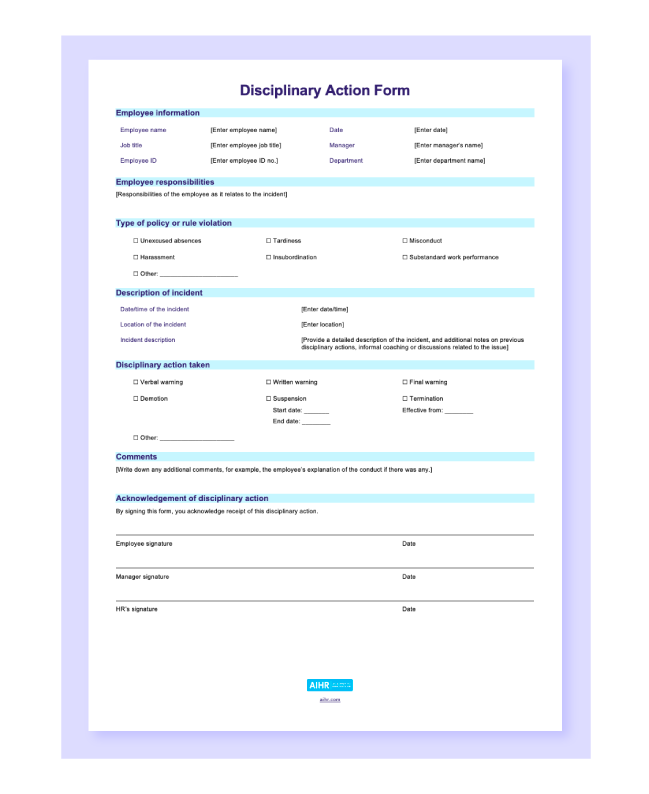
Disciplinary action form template
A disciplinary action form template provides a consistent and fair way to handle employee misconduct while clearly recording and documenting the incidents and actions taken. We’ve created the template in both Word and PDF, and you can download them together as one template collection.
Disciplinary action letter template
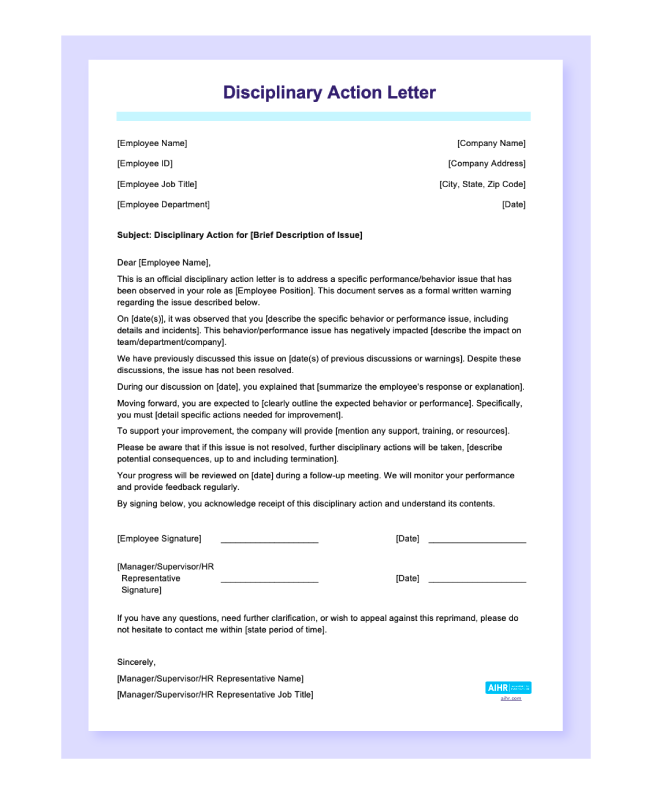
Using a disciplinary action letter ensures clear and formal communication of the issues, expectations, and consequences to the employee, reinforcing the seriousness of the matter. It also provides documented evidence of the steps taken and the employee’s awareness of the situation. This helps with legal compliance and provides a future reference point.
If you’re not sure how to write this letter, here’s a template that you can use:
Let’s take a look at two examples of disciplinary letters addressing specific workplace issues.
Disciplinary action letter for workplace theft
Disciplinary action letter for not following instructions
Disciplinary action policy: What to include
A strong disciplinary action policy sets clear expectations, explains how decisions are made, and helps managers apply corrective action consistently. Include the following elements:
- Purpose and scope: State why the policy exists (to correct behavior or performance issues and support a fair workplace), and whom it applies to (employees, managers, contractors, if relevant). Clarify who owns the process (manager and HR responsibilities).
- Definitions and examples: Define what your organization considers performance issues versus misconduct. Include a few concrete examples (e.g., attendance issues, insubordination, policy violations, safety breaches, harassment), so employees understand what can trigger disciplinary action.
- Progressive discipline steps: List the usual steps in order, such as coaching, verbal warning, written warning, final warning, PIP (if necessary or applicable), suspension, then termination. Note that not every situation requires you to follow every step.
- When you may skip steps: Explain that serious misconduct (e.g., gross misconduct, violence, major safety violations, harassment, theft) may lead to immediate escalation. This helps you handle high-severity cases without contradicting your own policy.
- Investigation and fact-finding: Explain that HR must investigate before taking action, and what doing so typically entails (collecting information, conducting interviews, reviewing evidence, allowing the employee to respond). Mention that investigations are especially important in harassment, bullying, discrimination, and safety-related cases.
- Documentation requirements: Spell out what you must document at each stage, including verbal warnings. List the basic information a write-up should capture, like dates, an objective description of what happened, the policy or expectation involved, prior related actions, the impact, expectations moving forward, support offered, and consequences if the issue continues.
- Employee communication and acknowledgment: Explain how you’ll communicate disciplinary decisions to the employee and how acknowledgment works (signature/confirmation). Add a line on what happens if an employee refuses to sign (you document the refusal, but the process still moves forward).
- Roles and approvals: Define who can issue each level of discipline, and when HR review or approval is required (often for written warnings and beyond). This is especially crucial for maintaining consistency across teams.
- Appeals process: Outline whether employees can appeal, how they should do it, who reviews appeals, and expected timeframes. Keep it simple and practical.
- Confidentiality and non-retaliation: State that you’ll treat disciplinary matters as confidential where possible. Also mention that retaliation is not allowed, especially when discipline follows a complaint or participation in an investigation.
- Recordkeeping and retention: Explain where you store records (secure employee file), who can access them, and how long you keep them. You can keep this high-level if retention varies by location.
- Policy review and updates: Include how often you review the policy and update examples, especially when work conditions change (hybrid/remote work, new systems, updated conduct standards).
To conclude
Taking disciplinary action is rarely easy for anyone involved. However, a clear disciplinary action policy that outlines unacceptable behaviors, explains how issues will be addressed, and defines the steps employees can take to improve makes the process much easier to manage fairly and transparently.
It also helps create consistency across cases, gives managers a practical framework to follow, and helps employees better understand what is expected of them. When handled properly, disciplinary action is not only a way to address problems but also an opportunity to support accountability, improvement, and better workplace standards.
FAQ
Disciplinary action is a corrective step a company takes when an employee doesn’t meet expected standards for performance or workplace behavior. It’s meant to address and improve the issue, not punish the person, and it creates a clear record of what happened and what needs to change. It can range from coaching or a verbal warning to written warnings, a performance improvement plan, suspension, or termination, depending on severity and whether the issue continues.
A common example of disciplinary action is a written warning. For instance, if an employee repeatedly arrives late, their manager issues a written warning that documents the dates of the incidents, explains the impact on the team, and sets clear expectations for improvement, along with the next steps if the issue continues.
A disciplinary action is an internal corrective step an employer takes to address an employee’s behavior or performance, like a verbal or written warning, a performance improvement plan, or suspension. The goal is to help the employee correct the issue and to document expectations and next steps.
An adverse action is a broader term for an employer decision that negatively affects an employee’s job or work conditions, such as termination, demotion, pay cuts, or reduced hours. In practice, some disciplinary actions can also be adverse actions, especially if they involve a tangible job impact (e.g., suspension, demotion, or termination).
Not necessarily. Disciplinary action covers a range of corrective steps meant to address a performance or behavior issue. Most of the time, it starts with less severe measures like coaching, a verbal warning, or a written warning. Firing (termination) is usually the last step, or is used when the issue is serious (e.g., gross misconduct).