

Succession planning is essential to ensure critical roles in a company are not left vacant for extended periods or filled by people who lack the skills or knowledge to perform the role. Knowing who’s next in line to fill senior positions and mentoring these people to become your company’s next generation of successful leaders is crucial to maintaining a competitive edge and team morale.
This succession planning guide will explore the concept in depth, explain why it’s important, share best practices, and provide a framework any organization can apply. You’ll also find a free succession planning template collection you can use to map critical roles, assess potential successors, and plan leadership development.
Contents
What is succession planning?
What’s the role of HR in succession planning?
Why is succession planning important?
Succession planning model
Succession planning framework
Succession planning process: 4 key steps
How to create a succession plan
Free succession planning template collection
Succession planning examples
Succession planning best practices
Succession planning software and tools HR can use
FAQ
Key takeaways
- Succession planning helps organizations keep critical roles filled and reduce disruption when key employees leave.
- HR plays a central role in identifying critical positions, assessing potential successors, and creating development plans.
- An effective succession planning process connects talent development, leadership development, and business continuity.
- Succession planning templates and tools can help HR map roles, readiness levels, development actions, and ownership.
What is succession planning?
Succession planning is the process of selecting and developing key talent to ensure the continuity of critical roles. It’s about identifying top performers and potential leaders and mentoring and developing them, so they can advance in the organization and move into top-level roles.
Employees get promoted, move companies, and retire every day. That’s why you need a solid plan to ensure positions are filled by people equipped to do the job.
Let’s further unpack the definition of succession planning.
- First of all, succession planning is about critical roles. Not all roles are relevant for succession planning. It should focus on roles vital to the organization’s competitiveness and continuity. A junior sales rep is fairly easy to replace. However, the VP of Sales role is one you don’t want to leave unfilled for long, if at all.
- Second, the focus is on selecting and developing key talent. This means the best and brightest are identified and nurtured for critical roles. Most of the time, succession planning happens with internal candidates. For example, the Director of Sales is groomed to fill the VP of Sales role, while the VP of Sales progresses into the CEO position. Occasionally, external candidates are hired and brought up to speed before taking on a new role, though this is often on an ad hoc basis. As an organization grows, it’s more cost-effective to develop and promote from within.
- The last part of the definition is to ensure continuity. This is the ultimate purpose of all this work: to ensure that when someone leaves, someone else is ready and qualified to take over that role and be productive in no time.

What’s the role of HR in succession planning?
HR plays a significant role in succession planning, including identifying successors in the organization, creating and implementing development plans and programs, monitoring progress and providing regular feedback, instilling a culture of succession planning, and encouraging all employees to think about their career paths, ensuring diversity and inclusion throughout the process, and adapting to evolving internal and external factors.
As the linchpin that links various departments together, HR can:
- Collaborate with organizational leadership to develop an effective succession plan
- Work with leaders to determine the strategic direction and future needs of the organization, ensuring that the succession plan aligns with long-term business objectives
- Identify key positions that are critical to the organization’s success and understand the competencies required for these roles
- Engage employees in the succession planning process by involving potential successors in their development plans
- Ensure that employees are committed to their growth and prepared to take on new responsibilities
- Promote a sense of ownership and motivation among employees by providing clear career advancement pathways within the organization.
The role of HR in succession planning is about much more than filling vacancies. It’s centered on ensuring an organization can adapt and continue to thrive today and in the future.

Why is succession planning important?
Succession planning is important for the success of an organization for many reasons:
- Business continuity and risk management: A succession plan reduces risk and disruption, ensuring business continuity in the event of an unexpected departure. Trainer & Team Performance Consultant Lindsay Dunlap elaborates on the risk a lack of a succession plan can cause. “Many companies are not taking time to get new leaders up to speed, so they are tossed in to figure it out as they go. New leaders are left stressed out, fearful of asking for help, and then they are held accountable to standards and expectations that they may not fully understand. This leads to higher turnover in very vital positions for companies,” notes Dunlap.
- Organizational stability: A well-structured succession plan contributes to the organization’s overall stability, ensuring smooth and orderly leadership transitions, which can positively affect employee morale and confidence in the company’s future.
- Knowledge transfer: If a leader leaves unexpectedly, how much knowledge is walking out the door with them? Proactively preserving institutional knowledge ensures that valuable insights and expertise are not lost when key employees depart.
- Retaining top talent: Succession planning gives high-potential and high-performing employees a clear career path in your organization. In turn, that boosts engagement and allows you to save money on hiring external senior employees and executives.
- Helping to plan and prepare for the future based on different scenarios: This reassures shareholders that the business is well taken care of in the long term. “Organizations that fail to plan or create a succession pipeline successfully run the risk of losing the confidence of their stakeholders and investors from uncertainty and unfamiliarity,” explains Jenna Fisher, Managing Director at the executive search and leadership advisory firm Russell Reynolds Associates and author of To the Top: How Women in Corporate Leadership Are Rewriting the Rules for Success.
- Leadership development: A succession plan presents a structured approach to preparing a new generation of leaders to steer your organization forward.
- Preventing conflict: Without a clear succession plan, power struggles may arise within the company. Different people and groups might start competing for dominance. This dysfunctional conflict makes it more difficult to achieve organizational goals.
To sum it up, succession planning enables you to grow your company and your people.
Obtain the skills you need to help conduct structured talent reviews, data-driven assessment, and development planning to make succession planning work for your organization
AIHR’s Talent Management & Succession Planning Certificate Program covers how to:
✅ Identify critical roles and future talent needs
✅ Run talent mapping and succession planning processes
✅ Build leadership talent pools and development pathways
✅ Use talent data to support proactive workforce decisions
🎓 Learn how to future-proof your organization’s talent supply.
Succession planning model
The succession planning model depicted below is an adaptation of Groves (2005), who proposed an integrated leadership development and succession planning model. Talent is developed, and leadership talent is spotted, identified, actively developed in leadership programs, and prepared for succession. We tweaked this model to make it more applicable to succession planning.
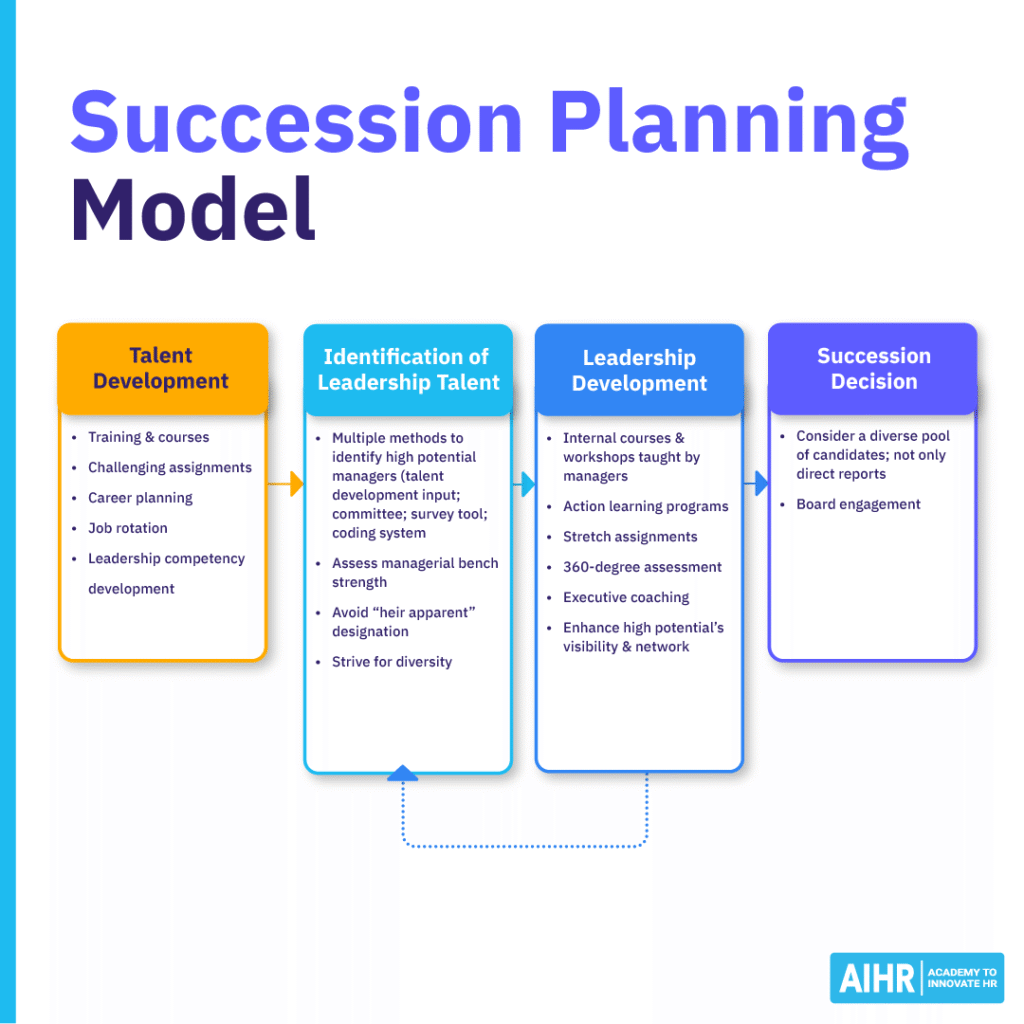
In the next section, we will explain each step of this succession planning model in detail and discuss the preconditions required for effective succession planning.
Succession planning framework
How can we design and implement a practical process that streamlines our succession planning efforts? Using a succession planning framework helps you make sure that your method is consistent and effective.
Our succession planning framework has two preconditions:
- Creation of a culture of leadership development
- Selection of critical roles.
Precondition 1: A culture of leadership
For succession planning and long-term leadership development to succeed, there must be a clear commitment from senior management, including the CEO.
Senior managers and C-level executives must actively participate in developing young talent. For example, senior leaders can be involved in mentoring activities and help successors develop leadership competencies.
In addition, managerial performance appraisal and reward processes should incorporate leadership development activities, including the identification and development of high-potential employees.
Precondition 2: Selection of critical roles
As we’ve already mentioned, critical roles are those that, if vacant for a few months or filled by a bad hire, would lead to significant damage to the company. A CEO would certainly be such a role. Yet, a global survey showed that 53% of companies did not have a CEO succession contingency plan in place.
The easiest way to identify these roles is to look at the most senior people in the organization’s hierarchy or the highest earners. If the organization has a well-defined job architecture with function descriptions and rewards based on responsibilities, this selection will be fairly accurate.
If there’s no clearly defined job architecture, an alternative is to rank functions by importance. For example, a CEO is more important than a CFO. The CFO is often considered more important than the CTO. This way, you can identify the top functions within your business.
Regarding leadership functions, it’s best practice to avoid including too many roles and to aim for the top 0.5% of the organization. Selecting too many critical positions will make it harder to maintain your managerial succession bench strength. The reason is that you need multiple people on the bench to replace a single senior executive.
Succession planning process: 4 key steps
Once the two preconditions are met, HR can put the succession planning process in motion. The four-step process is based on the succession planning model discussed above and helps organizations move from broad talent development to a clear succession decision.
In practice, these steps help HR identify critical roles, build a leadership pipeline, assess successor readiness, develop future leaders, and make evidence-based succession decisions.
The key succession planning process steps are:
Let’s explore each step in more detail.
Step 1. Talent development
Taking a long-term approach to succession planning and combining it with talent and leadership development are two of the best practices when creating a succession planning strategy. Why? Because succession planning generally focuses on senior leadership roles that would be replaced by employees currently in mid-level leadership roles. So it makes sense to integrate talent and leadership development with succession planning.
The succession planning process starts with regular talent development. Many organizations have talent development programs that provide high-potential employees with training, varied assignments, and challenging assignments. Relevant talent management activities focus on career planning and job rotation to gain more experience and develop leadership competencies.
Mentoring is also a popular way to develop top talent. It’s widely reported that employees with mentors perform better, are promoted more quickly, and are compensated better. What’s more, they have more organizational commitment, personal learning, and job satisfaction, and are less likely to leave. There are also psychosocial benefits, including acceptance, encouragement, coaching, increased internal exposure, and more challenging assignments (Groves, 2005).
Step 2. Identification of leadership talent
Not everyone will succeed during talent development programs, which is why you need to continuously monitor and evaluate the participants. Those who aren’t suited to critical leadership positions may be great candidates for low— or middle-management positions.
This input from talent development programs helps identify leadership talent. Mentors, committees, surveys, and coding systems are tools that help assess managerial bench strength and serve as the basis for developmental activities. There are also succession planning tools and software that businesses can use to select and develop potential leaders.
In this phase, diversity is key. If diversity in the boardroom is already an issue for the organization, the diversity of succession candidates should be a top consideration in talent and leadership development programs. The more qualified participants from diverse backgrounds you involve in your programs, the greater your chances of building a more diverse future boardroom.
Step 3. Leadership development
In this stage, you develop those identified as having strong leadership potential further. This differs from your average talent development. For example, you organize internal courses and workshops for future leaders. They are encouraged to develop closer connections with organization leaders, as this will make them more effective in their future roles.
This group should also be exposed to active learning through challenging projects, stretch assignments (challenging tasks aimed at developing experience outside of an employee’s regular routine), 360-degree feedback to provide developmental feedback to managers, and executive coaching on skills they need to build.
“Having your succession candidate(s) be deeply involved in business operations that are critical to the role early on, such as mergers & acquisitions and relationship management, can be the key to their success,” says Jenna Fisher from Russell Reynolds Associates. Fisher says that was the case in the carefully orchestrated succession of Corie Barry, who succeeded Hubert Joly as CEO of Best Buy in 2019.
“Hubert’s process, which involved sponsoring and supporting a great woman leader, turned into what he described as “one of the things I’m proudest of in my career.” This method prepared Corie to accelerate the company’s growth strategy and be able to adapt to the pandemic when it began,” Fisher adds.
The succession planning model above shows a feedback loop between steps 3 and 2. Leadership development provides new input for measuring managerial bench strength, and the new information in this step will impact the identification of leadership talent.
Step 4. Succession decision
Based on the previous steps, you can create a succession matrix. In this matrix, you map potential successors for each function.
A key consideration in this step is the likelihood of people quitting the organization.
- Accurate assessment of the turnover rate for the critical roles identified earlier is key, as turnover in one of these roles will engage your succession plan. For example, lining up five people to replace the role of a CEO who is intent on staying for the next 10 years will only lead to frustration. Likewise, having just one potential successor for the COO, even though there’s a high likelihood they will quit, is very risky and demonstrates a lack of planning.
- Turnover in the leadership talent group is less disruptive but still very costly. This group is extensively trained and integrated into your succession plan. Not only will this result in extra costs for the business, but this turnover can disrupt the entire succession planning strategy for the organization. Therefore, managing expectations and monitoring turnover are key steps to be mindful of at all times.
Whenever someone occupying a critical role quits or retires, you should make a succession decision. If not already in place, you need to create an onboarding program together with the leaver. Such a program with clear targets will enable the successor to get up to speed as quickly as possible.
How to create a succession plan
Writing a comprehensive succession plan involves several key steps, each building on the model and framework outlined above. Before you start, it helps to understand what the plan should include.
A succession plan should include the critical role, current role holder, potential successors, each successor’s readiness level, required competencies, development actions, timelines, success measures, and the person responsible for reviewing the plan. It should also include an emergency replacement option for sudden vacancies.
Here’s a detailed guide on how to proceed step by step:
1. Develop a succession planning chart
Begin by creating a succession planning chart that outlines the structure of your plan. This chart should visually represent the key positions within the organization and potential successors. It serves as a roadmap for your succession planning, providing a clear overview of where the organization stands and where it needs to focus its development.
2. Identify key positions
Identify which roles are essential for the organization’s strategic goals. These are typically leadership or specialized skills positions. Develop competency models for these key positions, outlining the skills, experiences, and attributes necessary for success. This step ensures clarity on the requirements for each critical role.
3. Assess current talent
Conduct a thorough assessment of your current talent pool. This involves creating a talent inventory and performing a skills gap analysis. Use tools like employee evaluations, 360-degree feedback, and talent reviews to gauge employees’ current capabilities and potential for future roles. Remember, your goal is to identify high-potential individuals who can be developed into future leaders.
4. Create successor profiles
Detailed profiles for potential successors should include their current skills, experiences, and development needs. Highlight their strengths and areas for improvement and document their career aspirations. Completing this step gives you a clear understanding of each potential successor’s readiness for advancement.
5. Create individual development plans (IDPs)
Knowing which roles should have succession plans in place and which top talent in your organization could potentially fill them is one thing. Getting them ready for those roles is what the succession planning process is all about. The process should outline specific development activities and goals tailored to bridge any skills gaps identified during the assessment phase.
IDPs may include training programs, mentorship, job rotations, and other developmental activities designed to prepare individuals for future roles.
6. Implement development strategies
Effective development strategies must align with the IDPs. These strategies should focus on providing potential successors with the experiences and learning opportunities they need to develop the competencies required for key positions. Development strategies might include leadership training, cross-functional projects, and exposure to different areas of the business.
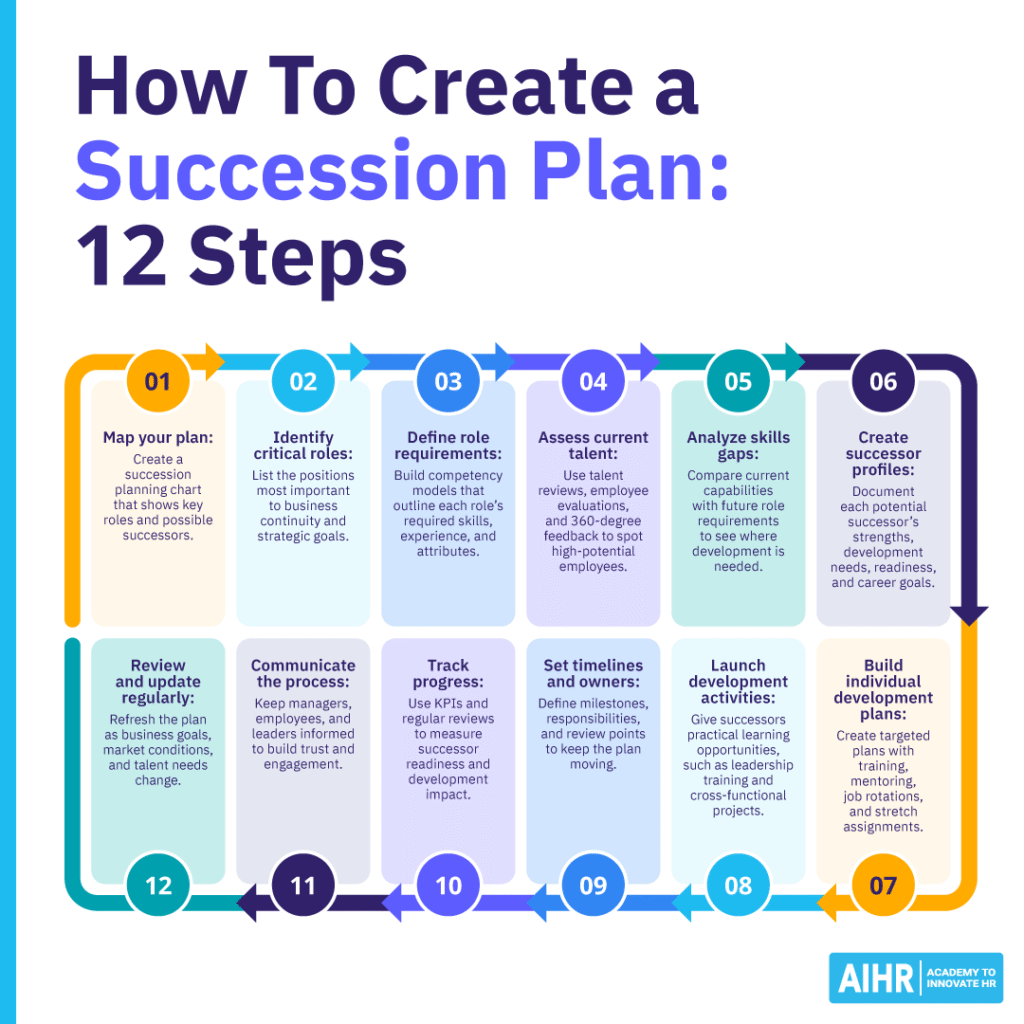
7. Put the plan into action
Create a detailed implementation plan, including timelines and milestones, for the succession planning process. This plan should outline when each development activity will take place and who will oversee its implementation. Having a clear timeline helps ensure that the succession planning efforts stay on track and progress is regularly monitored.
8. Track and evaluate
Establish Key Performance Indicators (KPIs) and review processes to track the progress of your succession plan. Regularly evaluate the readiness of potential successors and the effectiveness of the developmental activities. Use these evaluations to make necessary adjustments to the plan and continuously align with the organization’s strategic goals.
9. Communicate your succession plan strategy and process
Develop a communication strategy to keep all stakeholders informed about the succession planning process. Clear, transparent communication helps manage expectations and encourages employee engagement. Regular updates on the progress and success of the plan can also reinforce the organization’s commitment to employee development.
10. Review and update the plan
Succession planning is an ongoing process that requires regular review and updates. Periodically revisit the succession plan to keep it relevant and effective in light of any changes in the organization’s strategic direction, market conditions, or internal talent dynamics. Continuous improvement of the plan helps the organization stay prepared for future leadership transitions.
11. Engage stakeholders
Various stakeholders, including managers, employees, and external partners, should be engaged in the succession planning process. Their input and support are vital for the success of the plan. Involve them in key stages such as assessments, development planning, and evaluations to ensure a comprehensive and inclusive approach.
12. Integrate with strategic goals
Finally, ensure the succession plan fully aligns with the organization’s strategic goals. When your succession plans align with the company’s overall vision and objectives, you ensure that the development of future leaders supports the organization’s long-term success and growth.
How do you write a simple succession plan?
When you’re just introducing succession planning at your organization, a simple succession plan for a couple of critical roles is a great starting point.
Here are some steps to help you write a simple succession plan:
- Create a list of your succession priorities and goals
- Use a succession planning template to streamline the process, as templates provide a structured format that can be customized to fit your organization’s needs
- List critical positions within your organization, determine why these roles are critical to your operations, and rank them in order of importance
- Specify the core skills, experience, and qualifications necessary for each role
- For each key position, identify internal candidates who could potentially fill the role
- Assess each candidate’s current skills and the development needed to prepare them for the role
- Outline specific training, mentoring, and development opportunities for succession candidates
- Set timelines and milestones for candidate development
- Develop a plan for sudden vacancies, including interim successors and emergency procedures
- Clearly outline who steps in immediately if a key position becomes suddenly vacant
- Make sure the plan is in a clear, accessible format.
Free succession planning template collection
AIHR has assembled a free succession planning template collection to support you in succession planning for your organization. Each template is free to download, customizable, and made to help streamline your succession planning process. You can adapt them to suit your company’s culture and business goals.


Succession planning examples
What does succession planning look like in practice? Here are three examples of succession planning:
Example 1: McCormick & Co
In 2008, McCormick & Co transitioned their CEO, Robert Lawless, to his successor, Alan Wilson, using a thoughtful and comprehensive succession planning strategy that they confidently executed. Lawless devised a timeline spanning five years, in which he transitioned to a non-executive chairman of the board role. He also used a portion of his discretionary compensation to find and prepare the right person to take on his position.
The succession plan was developed over many years to identify and create development strategies tailored to all senior executives. The organization monitored the progress of candidates for several years before Wilson was chosen as the successor, based on his strong alignment with the company culture and understanding of top-line issues.
Example 2: Barney’s New York
In 2017, Mark Lee stepped down from the CEO role and was replaced by Daniella Vitale, who joined Barneys in 2010. She had a long history of high-end fashion retail experience since graduating and was considered “uniquely qualified” to succeed in this position.
In the lead-up to the official changeover, Vitale was given numerous leadership opportunities, the chance to run almost every facet of the organization, and substantial mentorship from Lee, who played a large role in developing a formal five-year succession plan for her.
Example 3: Sample succession plan for critical roles
Here’s an example of the list of steps for a succession planning process and what a typical succession plan might look like.
- The primary goal of this succession plan is to grow our people and our business by identifying and nurturing talent to transition into leadership roles in the event of retirement, resignation, unforeseen health reasons, or tragedy.
- Positions under consideration:
- CEO – Sheila Patel
- CFO – Brian Connelly
- VP – Yasmin LeBron
- District Manager – Russell Brown
- *At the time of retirement, a Regional Manager position will be created, and the responsibilities will be divided accordingly.
- Director of Marketing – Amanza Larkhani
- Current employees who plan to retire over the next five years:
- Brian Connelly
- Amanda Larkhani
- Qualifications for these key roles include:
- CFO
- 10-15 years of finance experience
- Strong leadership skills and experience
- A professional finance qualification
- Director of Marketing
- An impeccable creative portfolio
- 8+ years of marketing experience with relevant brands
- CFO
- The current candidates for the key roles in order of readiness are:
- CFO:
- Shane Thompson
- Vijay Shar
- Tulisa Sulliman
- Director of Marketing:
- Nisha Edwards
- Grant Mackenzie
- Gosia Peirce
- CFO:
Succession planning best practices
While succession planning clearly brings many benefits to your business, only 34% of organizations consider their succession planning process highly effective.
Applying succession planning best practices can help organizations overcome common succession planning challenges, like adopting a long-term perspective and following through on development plans. Let’s explore these best practices in more detail.
Adopt a long-term perspective
Amsterdam-based soccer club Ajax has historically been one of the most successful clubs in the world, producing talents like Johan Cruyff, Patrick Kluivert, Wesley Sneijder, and Luis Suárez. One reason the club has been so successful is its long-term perspective.
Talent is scouted early. Children as young as 7 join the Ajax Youth Academy. As the children age, the best ones get promoted to higher divisions. The most successful players end up living their dream: playing in the Premier League.
This is an excellent example of Ajax’s long-term, strategic perspective. The club nurtures talent for at least ten years before they join the Premier League team. Whenever a player of that team leaves, Ajax has multiple candidates lined up who can replace them, regardless of the position in the field.
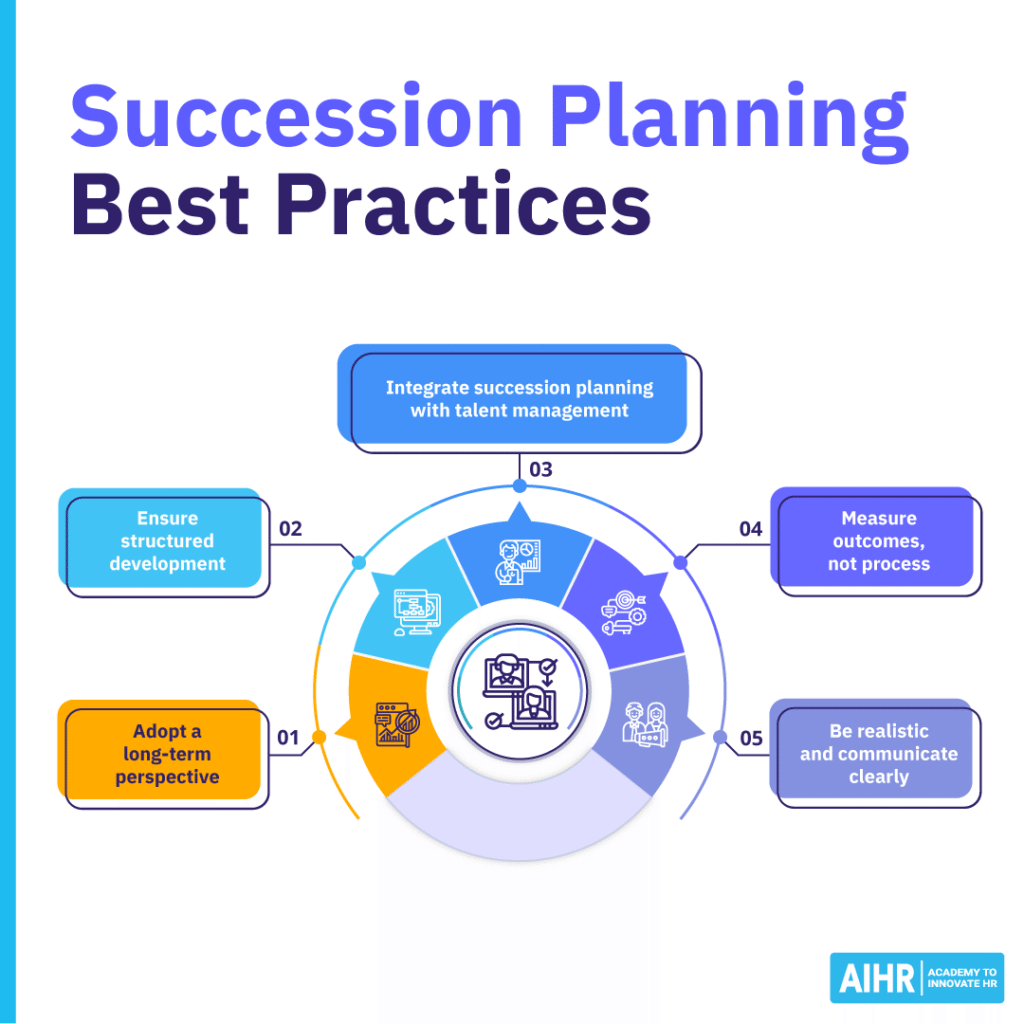
Ensure structured development
Having a well-structured development process in place is vital to effective succession planning. Such a process allows people to train and acquire the skills they need to move into a critical role in the future.
It’s essential to link succession planning to learning and development actions. These can include the development of specific skills or for employees to gain broader career experience in different functions, units, or geographical locations.
According to Jay Barrett, Founder & HR Executive of the HR consultancy Culture Canopy, you need to ensure holistic skills development.
It’s also important that different groups receive the most appropriate training. For example, developing a director to become VP requires a different approach than developing a VP to become CEO.
Companies use different learning and development methods to prepare successors for their next role. 83% of organizations use mentoring and coaching to develop succession candidates, 72% use formal learning, and 70% use stretch assignments.
Integrate succession planning with talent management
Succession planning is a form of talent management, so aligning succession and leadership development practices with existing talent management practices makes sense, as we discussed above.
Talent management begins with the employee and explores how their career path and skills can develop within the company. Succession planning focuses on the critical roles that need filling. Once you identify these roles, you can start thinking about which candidates would be a good fit for them. Integrating these two practices helps maximize key talent retention and create a thoughtful succession plan.
Measure outcomes, not process
Leaders and executives pay attention to tangible metrics. If you don’t set and track succession planning goals, it won’t be easy to gain buy-in from leaders and ensure the process is successful. Plus, working with the leadership team to determine goals helps garner that crucial support, and the results will point to where you need to make improvements in future succession planning efforts.
Here are some common succession planning metrics to track:
- Number of high potentials (HiPos) identified for each critical role
- % of critical positions filled internally
- High potential turnover
- Bench strength
- Pipeline utilization
- % of interviewees for a critical role
- Number of successive promotions.
In other words, track metrics that focus on outcomes instead of processes. The number of talent or succession programs in place would be an example of a process metric you should avoid.

Be realistic & communicate clearly
Marshall Goldsmith, an executive educator and coach, gives the example of an accomplished engineer who has the potential to become COO. To do that, they need to gain more sales experience, but the company would never risk putting someone without sales experience in a top sales job. This demonstrates the importance of being realistic when creating a succession plan.
It’s just as important to manage succession expectations. If the talented VP of sales is being mentored and developed to be CEO, they may leave the company disgruntled when the board decides to keep the CEO for another four years or replace them with an external hire. Clear communication and management of people’s expectations are crucial for effective succession planning.
Tara Furiani, “Not the HR Lady,” keynote speaker and consultant, highlights the importance of prioritizing communication throughout the succession planning process.
“This includes keeping employees informed about the organization’s goals and vision, as well as providing regular updates on the status of the succession planning process. Open lines of communication can also help build trust and engagement, which can go a long way toward ensuring the success of the plan,” Furiani notes.
Succession planning software and tools HR can use
Succession planning software and tools help HR teams identify, prepare, and develop employees who can step into critical roles in the future. These tools can range from simple Excel templates to more advanced platforms with features like competency mapping, readiness tracking, development plans, talent pools, and HRIS integration.
Common succession planning tools include:
- Simple succession planning template: A spreadsheet template is a practical starting point for organizations building their first succession plan. It can help HR map critical roles, current role holders, potential successors, readiness ratings, key competencies, development plans, KPIs, review frequency, and the contact person to notify if a role becomes vacant.
- CEO succession planning template: For executive roles, a CEO succession planning template helps the board or leadership team define the ideal successor profile, compare internal and external candidates, and align on priorities for selecting and preparing the next leader.
- 9 box grid: The 9 box grid helps HR assess employees based on performance and potential. This makes it easier to identify high-potential, high-performing employees who may be strong candidates for future leadership roles.
- Succession planning software: Larger or more complex organizations may use dedicated software, such as Built, ClayHR, Cornerstone OnDemand, or TalentGuard, to track successors, review promotion readiness, create talent pools, map competencies, monitor flight risk, and keep succession plans updated.
A final word
Effective succession planning helps you keep critical roles filled, support business continuity, and give high-potential employees a clear path to grow. It also strengthens engagement and retention because employees can see a future inside the organization.
If you don’t yet have a succession plan for your key positions, now is the time to take a proactive approach. Start by identifying your most critical roles, mapping potential successors, and creating development plans that prepare employees for future opportunities.
To build these skills further, explore AIHR’s Talent Management & Succession Planning Certificate Program. You’ll learn how to manage talent pipelines, identify and develop future leaders, use talent data, and build succession strategies that support long-term business needs.
FAQ
Succession planning in HR is the process by which organizations prepare employees to step into critical roles when the time comes. HR guides this process by helping leaders identify key positions, understand future talent needs, and develop employees who could grow into those roles. This makes succession planning part of broader talent management, leadership development, and workforce planning.
The benefits of succession planning include stronger business continuity, smoother leadership transitions, better retention of high-potential employees, improved knowledge transfer, and lower hiring risk for critical roles. It also helps HR build a stronger leadership pipeline by identifying future talent early and creating development plans that prepare employees for key positions.
Succession planning is not just for executive positions; it applies to all critical organizational roles. Critical means any role that plays a significant part in the daily operations of the business, and without whom operations would be compromised.
1. Talent development – Developing high-performing and high-potential employees through training, assignments, and job rotation.
2. Identification of leadership talent – Identifying high-potential managers, assessing the strength of the managerial bench, and keeping options open at this stage.
3. Leadership development – Those with high potential to perform in critical positions are given leadership development opportunities to boost their skills and experience.
4. Succession decision – A decision is made, and a list of potential successors is ranked from the most qualified for each critical role, and made aware of the decision so that expectations are managed.
The most common mistake in succession planning is identifying potential successors but failing to actively develop them. A succession plan only works when HR and business leaders turn successor lists into clear development actions, such as mentoring, stretch assignments, leadership training, and regular readiness reviews.
The terms succession planning and succession management are often used interchangeably, but there are key differences between the two.
Succession planning focuses on identifying and developing specific high-potential employees for critical roles. It involves developing and replacing key people in the organization over a set period (usually 5-10 years).
In contrast, succession management focuses on building a strong leadership map and developing talent benches for key roles. It takes a broader, more holistic review of all leadership positions.